I know I haven't really used my blog as an emotional dumping ground the way a lot of people I know have done with their blogs. But I'm making an exception today and therefore decided to shout out an "achtung!" right at the very start so that you are clear on the content that's coming up and can flee right away if this kind of thing induces any kind of inflammation, watering of eyes or other allergic reactions in you.
The only reason I'm doing this is to clear out my head and because even I think my friends need a break from listening to my small-big issues when I know for a fact that a lot of them have plenty of their own to sort out! I still want to take a moment here to tell my friends that you (you all know who you are) are all stars and are an incredible source of respite and joy. I know that my friends know how much I love them for it but I'm not sure they know just how proud I am of them.
There is something about the twenties that makes it such a tough period to go through. I, for one, think that it is all the things that I was not able to forsee about life at this age that makes it abstruse. For example, what I did not know while growing up is that when you reach your twenties, everybody around you (who is not in their twenties) assumes that they have a right to size you up and not even be discreet about it. I don't know if this happens with most twenty and odd year olds or if I have an exceptionally raw deal on my hands here- but I find that in any social situation, questions that were earlier considered too personal to be asked by mere acquaintances can now be asked of you by total strangers. Whatever happened to discussing the weather, politics and cricket! On one fateful day, they get replaced by work, marriage and fitness and you will need to have ready convincing answers to questions pertaining to these topics to save yourself the misery of listening to clichés carelessly passed off as advice.
Then comes the tougher part- in that critical change that takes you from being a dependent in the governement records to a productive tax payer, there are whole new dimensions to your personality that develop, which make you feel like a stranger in your own skin at times. And when it comes to such changes from within, it takes a while to understand and accept that you may have the most wonderful entourage- and I'm using the word in the Facebook sense- but there isn't really anyone else but you who can help you deal with it.
I do not mean to paint a melancholic picture of what is universally acknowledged to be the most magical part of the average person's life. God knows, I have always longed for the kind of independence I now enjoy. And the changes and responsibilities that initially seem daunting begin to look exciting on getting used to them. But then there are times when I realise just how significant an impact some of the decisions I take now can have on the way the rest of my life shapes up- and it is at such times that I cave into the pressure and get into melodrama-mode because I do not know if I am able to judge the consequences of my decision well enough. It also seems like it is just us girls who feel the compelling need to express how hard this can be- the guys seem to handle it rather well- but then I know they have their moments too, they just occur less often and can be made to snap out of it more easily, which, of course is a marvelous thing. But there are times when I really wonder if the kind of decisions we need to deliberate over and a greater burden of social conformity makes this harder for women. I don't think there's just one correct answer to that question.
I have begun to digress now. Since this post was for my benefit just as I had mentioned earlier, it seems like it has served its purpose and now would be a good time to end it- also Alanis Morissette is playing on my playlist and like she says "And what it all boils down to/ Is that no one's really got it figured out just yet".
Monday, April 28, 2008

Wednesday, March 26, 2008
Getting high on masala chai
Well, I’m back from the UK and it already feels like I was never away. I’m also just back from a short but very memorable trip to Kodaikanal with my colleagues.
The timing of our trip was not exactly perfect what with the perpetual showers and a constant thick cover of fog over what were considered to be the best sights around. Despite this, we ended up enjoying our brief stay in Kodai and I was busy relishing some of the many little pleasures of traveling in India that I sometimes pined for while in England- like having endless cups of masala chai and paying for them in Rupees.
It is surprising to see how my idea of what is symbolic of India and to some extent, our national pride has changed ever since I have come back. My idea of these themes and objects now coincides with what a first-time tourist or an Indiaphile who has never visited India would imagine them to be. This is not because a mere 6 month stint abroad makes me think like a firang but more so because I am now probably able to see what India is that not many other countries can be.
Even a few months ago, I was annoyed to see how India was depicted as this strange, exotic land that is a destination for spiritual fulfillment for dummies in The Darjeeling Limited. But now, I see nothing wrong with this description- I would probably only explain to the uninitiated that this too but not solely, is India.
I now see nothing wrong with a tourist defining India by the box of spices in the average Indian home, the stray animals on the road that have a sophisticated sense of traffic etiquette, the colours, the cacophony of dialects, the scary traffic, Bollywood and whatever other stereotypical image there is of India (but no, not snakes and snake-charmers- I take exception to that one – it is surprising just how many people are still told the “India is a land of snake-charmers” story and how many people buy it!) I now see all of these things as catalysts in making the experience of living in India a very entertaining mind exercise. I do not know if I am right in thinking so but I am now of the opinion that we use our creativity and judgment rather well while living in an environment where we take nothing – rules, penalties, liberty- none of it for granted.
India, in some ways seems like the punk district of Camden in London, in standing for the alternate as against the regular- with the exception that we are regular people leading regular lives which just happen to be in essence unusual, without anyone really trying to make a statement. This is why I would recommend India to anyone who is looking for a holiday that is going to play havoc with their idea of the quotidian. The more practical side to it is that it just happens to be a huge landmass that can offer starkly diverse experiences and it is all easily available with a single visa and a single currency.
I can see that my outpour of nationalistic sentiments is eerily close to sounding like a copy for Incredible India . I think I might have fallen prey to the “saare jahaan se achcha” syndrome, which I suspect affects every true blue Hindustani returning from his/her first trip abroad- which is why I cannot be blamed for this post.
The timing of our trip was not exactly perfect what with the perpetual showers and a constant thick cover of fog over what were considered to be the best sights around. Despite this, we ended up enjoying our brief stay in Kodai and I was busy relishing some of the many little pleasures of traveling in India that I sometimes pined for while in England- like having endless cups of masala chai and paying for them in Rupees.
It is surprising to see how my idea of what is symbolic of India and to some extent, our national pride has changed ever since I have come back. My idea of these themes and objects now coincides with what a first-time tourist or an Indiaphile who has never visited India would imagine them to be. This is not because a mere 6 month stint abroad makes me think like a firang but more so because I am now probably able to see what India is that not many other countries can be.
Even a few months ago, I was annoyed to see how India was depicted as this strange, exotic land that is a destination for spiritual fulfillment for dummies in The Darjeeling Limited. But now, I see nothing wrong with this description- I would probably only explain to the uninitiated that this too but not solely, is India.
I now see nothing wrong with a tourist defining India by the box of spices in the average Indian home, the stray animals on the road that have a sophisticated sense of traffic etiquette, the colours, the cacophony of dialects, the scary traffic, Bollywood and whatever other stereotypical image there is of India (but no, not snakes and snake-charmers- I take exception to that one – it is surprising just how many people are still told the “India is a land of snake-charmers” story and how many people buy it!) I now see all of these things as catalysts in making the experience of living in India a very entertaining mind exercise. I do not know if I am right in thinking so but I am now of the opinion that we use our creativity and judgment rather well while living in an environment where we take nothing – rules, penalties, liberty- none of it for granted.
India, in some ways seems like the punk district of Camden in London, in standing for the alternate as against the regular- with the exception that we are regular people leading regular lives which just happen to be in essence unusual, without anyone really trying to make a statement. This is why I would recommend India to anyone who is looking for a holiday that is going to play havoc with their idea of the quotidian. The more practical side to it is that it just happens to be a huge landmass that can offer starkly diverse experiences and it is all easily available with a single visa and a single currency.
I can see that my outpour of nationalistic sentiments is eerily close to sounding like a copy for Incredible India . I think I might have fallen prey to the “saare jahaan se achcha” syndrome, which I suspect affects every true blue Hindustani returning from his/her first trip abroad- which is why I cannot be blamed for this post.
Sunday, November 25, 2007
Front seats for the sunset

Dreamy. Disoriented. Small.Charmed. Confounded. Captivated. Disturbed. Overwhelmed.
That is what going backpacking around Europe with my friends felt like.
Our itinerary was: (departure- 1st November) London- Brussels- Paris- Nice- Monaco- Venice- Rome- Vienna- Salzburg- (Linz)- London (arrival- 12th November).
There were several times during the trip when we found ourselves before a spectacular view when we weren’t really expecting it. It is one thing to know that you are heading towards a highly celebrated site but something else to turn a corner or climb a bridge or exit a metro station to suddenly see something so strikingly beautiful that everyone falls into a reverential silence before it. These silences and the gasps we let out were, to me, the essence of this trip.
Apart from the sights that worked their magic instantly, the trip was also one effective lesson in history, music, art, religion, politics and architecture. Sometimes, what we learnt about the lives of artists and composers and their times left us as stunned as did seeing an architectural wonder. We also have our cynic-sense in place and could partially see why a particular travel book describes Continental Europe as “that pile of elegant decay”. We did have our minor let-downs and the tourism-oriented marketing at some places did seem excessive. Despite any such flip-sides, I don’t think a trip to Europe can ever be anything less than extraordinary regardless of how and when it is done. All it takes is to see how an everyday occurrence as a sunset can seem like a grand opera in the backdrop of art and history and it becomes clear what the fuss is all about.
While the sights and sounds form the foreground of the trip, the researching, the unending debates while setting the itinerary, the reading of maps and figuring out the public transport systems and living in youth hostels, the great food we stumbled upon in places that inconspicuously happened in the background was equally significant in terms of recall-value. There is something about being a backpacker that makes it easy to talk to strangers and to other backpackers with itineraries that are more chaotic than our own. In almost every journey, our co-passengers shared with us stories of their own favourite fulfilling-yet-crazy trips after they discovered we were among the mavericks who holiday in their country in the wrong season. And very often, we would be asked “So where will your next holiday be?”. I was initially surprised that anyone was even suggesting we attempt another trip like this one, especially as it had been as more work than holiday with the visa application procedure and the bookings that sometimes wore us out. But then I now realize that my appetite for travel has just been kindled and it is a good state of mind to be in- to be planning for the next trip at any point of time. It places the business card, the deadlines, the worries and the task lists in perspective.
That is what going backpacking around Europe with my friends felt like.
Our itinerary was: (departure- 1st November) London- Brussels- Paris- Nice- Monaco- Venice- Rome- Vienna- Salzburg- (Linz)- London (arrival- 12th November).
There were several times during the trip when we found ourselves before a spectacular view when we weren’t really expecting it. It is one thing to know that you are heading towards a highly celebrated site but something else to turn a corner or climb a bridge or exit a metro station to suddenly see something so strikingly beautiful that everyone falls into a reverential silence before it. These silences and the gasps we let out were, to me, the essence of this trip.
Apart from the sights that worked their magic instantly, the trip was also one effective lesson in history, music, art, religion, politics and architecture. Sometimes, what we learnt about the lives of artists and composers and their times left us as stunned as did seeing an architectural wonder. We also have our cynic-sense in place and could partially see why a particular travel book describes Continental Europe as “that pile of elegant decay”. We did have our minor let-downs and the tourism-oriented marketing at some places did seem excessive. Despite any such flip-sides, I don’t think a trip to Europe can ever be anything less than extraordinary regardless of how and when it is done. All it takes is to see how an everyday occurrence as a sunset can seem like a grand opera in the backdrop of art and history and it becomes clear what the fuss is all about.
While the sights and sounds form the foreground of the trip, the researching, the unending debates while setting the itinerary, the reading of maps and figuring out the public transport systems and living in youth hostels, the great food we stumbled upon in places that inconspicuously happened in the background was equally significant in terms of recall-value. There is something about being a backpacker that makes it easy to talk to strangers and to other backpackers with itineraries that are more chaotic than our own. In almost every journey, our co-passengers shared with us stories of their own favourite fulfilling-yet-crazy trips after they discovered we were among the mavericks who holiday in their country in the wrong season. And very often, we would be asked “So where will your next holiday be?”. I was initially surprised that anyone was even suggesting we attempt another trip like this one, especially as it had been as more work than holiday with the visa application procedure and the bookings that sometimes wore us out. But then I now realize that my appetite for travel has just been kindled and it is a good state of mind to be in- to be planning for the next trip at any point of time. It places the business card, the deadlines, the worries and the task lists in perspective.
Sunday, November 04, 2007
Il fait beau sur la France!
This is Padma Sharma blogging from sunny Nice in France.
That is the most I can manage to get across with a French keyboard and after two days of talking in French. More shall follow when I return to good ole Brum.
P.S: I am heading to the beach now :)
That is the most I can manage to get across with a French keyboard and after two days of talking in French. More shall follow when I return to good ole Brum.
P.S: I am heading to the beach now :)
Friday, September 21, 2007
Somewhere Else
Well, there’s only one way to say this. I fell in love with a little Welsh sea-side town called Conwy 15 days ago- and hopelessly at that. The river Conwy flows through this town that is surrounded by purple-red flower-laden mountains and a grand 12th century castle runs along the town's perimeter. This basically means that from any given standpoint within Conwy, you are bound to find a picture postcard-like view before you that you want to capture and permanently freeze in your mind. Somehow, writing about my visit seems like it isn't the right way to save for posteriority the memories of the trip. When I write, it feels like I am trying to organize memories in convenient packages, just like those cans of processed food with their customary levels of preservatives that occupy miles of shelf-space in super-markets. And just like those cans, I know that anything I write will simply not have the intended effect.
This, my friends, is Conwy:


(pictures courtesy Trambak, Suryadip and Dam- muchas gracias guys! :))
P.S: I should have written this earlier- just that I did not have access to the internet at what is now "home". I am in the UK on work for the next five months. I would appreciate it if anyone has any suggestions on places that must be visited and things that must be done around here. We have been making our own plans too for almost every single weekend we'll be spending here- but then any local knowledge always adds significant value to what the maps and travel guides tell us.
This, my friends, is Conwy:


(pictures courtesy Trambak, Suryadip and Dam- muchas gracias guys! :))
P.S: I should have written this earlier- just that I did not have access to the internet at what is now "home". I am in the UK on work for the next five months. I would appreciate it if anyone has any suggestions on places that must be visited and things that must be done around here. We have been making our own plans too for almost every single weekend we'll be spending here- but then any local knowledge always adds significant value to what the maps and travel guides tell us.
Sunday, June 17, 2007
Making a point in 90 minutes
The only thing about me that has remained constant in the last one year has been the fact I have been reading regularly, irrespective of the extent of work load, the state of my mind and errm..my heart, the temperature, the migratory cycles of the local feathered population, the phase of the moon and other such variable factors. Since I would like to remember the details of some books that I have read recently, I have decided to blog about them for a while now.
The book “90 Minutes at Entebbe” by William Stevenson comprises of two main parts. The first and more significant part narrates the build-up to and the actual execution of one of the most well-planned and successful rescue missions carried out by a government in a foreign territory viz., the mission carried out by Israel in 1976 to rescue over a 100 of its citizens who were held hostage in Uganda by hijackers. The second part contains the transcript of the discussion that took place at the United Nations Security Council during the proceedings against Israel for alleged violation of Uganda’s sovereign rights in the course of the rescue mission.
The book states, while describing the process of planning the rescue mission, that there was one particular incident that convinced all the parties involved in decision-making that Israel must switch gears from diplomatic negotiations with the hijackers to direct military intervention. This incident involved the hijackers releasing all passengers of all nationalities on board the Air France plane that was bound to Paris from Tel Aviv but hijacked to Entebbe, Uganda, save the Israelis. Through this act of the hijackers, what had been an international crisis affecting several countries became solely Israel’s national concern. This act of the hijackers is said to have brought back to Israel’s collective consciousness, the memory of ‘Selekzia’- the term used by the Nazis to separate Jews from the rest of the crowd before sending the former to harrowing concentration camps.
This, the author seeks to establish, enabled the Israeli government to identify its immediate concern- that of saving the lives of its citizens, regardless of the consequences on its standing in the international community. The result was Operation Thunderbolt- an operation in which a fleet of 4 military aircrafts, in conditions of complete secrecy, took off for far off Uganda to bring back all the Israeli citizens on the midnight of 4th July, 1976 after a brief combat that left all the hijackers and some Ugandan troops dead. The deftness with which the mission was handled can be understood from the fact that the eccentric Ugandan dictator, Idi Amin, could not help praise the efficiency of the Israeli troops even as he was fuming about the loss of lives of Ugandan soldiers that this mission had caused. Incidentally, the exact role played by Idi Amin in this hijacking incident is not clear throughout the book,. There are parts where he comes across as sympathetic to the cause of the hijackers and others where he seems to have made a genuine effort at negotiating on behalf of the hostages.
There is a sense of irony that comes across towards the end because it is clear that Israel, through its meticulously planned and boldly executed rescue mission that lasted for only 90 minutes, made its stance regarding foreign policy and terrorism more eloquently than the Israeli diplomat could during the proceedings that lasted for days on end at the United Nations Security Council. While I was at my seat’s edge while reading about the mission and was taken aback by the precision with which it was executed, I was bored while reading the arguments put forth by the diplomat before the Security Council that come across as lukewarm and unconvincing (to me at least). On reading the entire transcript of the arguments, I could actually understand the cause for some of the ill-will that Israel had to face from other nations at the end of the hearings at the Security Council.
I completed this book in a little over a week while reading it in the morning in the bus on my tryingly long (sigh!) journey to work. Since I cannot help but think about work on my way there, I think this led me to look at the entire rescue operation from an efficiency of execution angle and left me admiring the planning skills of the Israelis. This does not, however, mean that I admire Israel’s military activism, since I have looked at things from an admittedly narrow perspective here. The book did make me wonder if, for a country to become exceptionally efficient militarily or economically, it takes the strong emotion generated by the memory of an incident (the Holocaust in this case) that has affected the individuals of the population at a personal level, only by dint of he or she being part of the bigger group. This also occurred to me when a colleague recently mentioned how it is widely believed that it was the shame of the memory of defeat in WW2 and the eagerness of the Japanese to wipe it out that contributed to Japan’s miraculous turnaround in the post-War years. This, too, seems to corroborate the notion that the psyche of a group is reflective of that of the individuals that constitute it. But then again, there could be a Fallacy of Composition at work somewhere here. It is possible that what may come across as a bold and domineering country in terms of its policies is made up of simple-minded individuals who can be satisfied with a good life and are not keenly ambitious for anything else. There must be millions of pages of printed matter out there about the role of the constituent individuals in influencing the mind of a group and I need to get my hands on some of it. Any recommendations will be deeply appreciated!
The book “90 Minutes at Entebbe” by William Stevenson comprises of two main parts. The first and more significant part narrates the build-up to and the actual execution of one of the most well-planned and successful rescue missions carried out by a government in a foreign territory viz., the mission carried out by Israel in 1976 to rescue over a 100 of its citizens who were held hostage in Uganda by hijackers. The second part contains the transcript of the discussion that took place at the United Nations Security Council during the proceedings against Israel for alleged violation of Uganda’s sovereign rights in the course of the rescue mission.
The book states, while describing the process of planning the rescue mission, that there was one particular incident that convinced all the parties involved in decision-making that Israel must switch gears from diplomatic negotiations with the hijackers to direct military intervention. This incident involved the hijackers releasing all passengers of all nationalities on board the Air France plane that was bound to Paris from Tel Aviv but hijacked to Entebbe, Uganda, save the Israelis. Through this act of the hijackers, what had been an international crisis affecting several countries became solely Israel’s national concern. This act of the hijackers is said to have brought back to Israel’s collective consciousness, the memory of ‘Selekzia’- the term used by the Nazis to separate Jews from the rest of the crowd before sending the former to harrowing concentration camps.
This, the author seeks to establish, enabled the Israeli government to identify its immediate concern- that of saving the lives of its citizens, regardless of the consequences on its standing in the international community. The result was Operation Thunderbolt- an operation in which a fleet of 4 military aircrafts, in conditions of complete secrecy, took off for far off Uganda to bring back all the Israeli citizens on the midnight of 4th July, 1976 after a brief combat that left all the hijackers and some Ugandan troops dead. The deftness with which the mission was handled can be understood from the fact that the eccentric Ugandan dictator, Idi Amin, could not help praise the efficiency of the Israeli troops even as he was fuming about the loss of lives of Ugandan soldiers that this mission had caused. Incidentally, the exact role played by Idi Amin in this hijacking incident is not clear throughout the book,. There are parts where he comes across as sympathetic to the cause of the hijackers and others where he seems to have made a genuine effort at negotiating on behalf of the hostages.
There is a sense of irony that comes across towards the end because it is clear that Israel, through its meticulously planned and boldly executed rescue mission that lasted for only 90 minutes, made its stance regarding foreign policy and terrorism more eloquently than the Israeli diplomat could during the proceedings that lasted for days on end at the United Nations Security Council. While I was at my seat’s edge while reading about the mission and was taken aback by the precision with which it was executed, I was bored while reading the arguments put forth by the diplomat before the Security Council that come across as lukewarm and unconvincing (to me at least). On reading the entire transcript of the arguments, I could actually understand the cause for some of the ill-will that Israel had to face from other nations at the end of the hearings at the Security Council.
I completed this book in a little over a week while reading it in the morning in the bus on my tryingly long (sigh!) journey to work. Since I cannot help but think about work on my way there, I think this led me to look at the entire rescue operation from an efficiency of execution angle and left me admiring the planning skills of the Israelis. This does not, however, mean that I admire Israel’s military activism, since I have looked at things from an admittedly narrow perspective here. The book did make me wonder if, for a country to become exceptionally efficient militarily or economically, it takes the strong emotion generated by the memory of an incident (the Holocaust in this case) that has affected the individuals of the population at a personal level, only by dint of he or she being part of the bigger group. This also occurred to me when a colleague recently mentioned how it is widely believed that it was the shame of the memory of defeat in WW2 and the eagerness of the Japanese to wipe it out that contributed to Japan’s miraculous turnaround in the post-War years. This, too, seems to corroborate the notion that the psyche of a group is reflective of that of the individuals that constitute it. But then again, there could be a Fallacy of Composition at work somewhere here. It is possible that what may come across as a bold and domineering country in terms of its policies is made up of simple-minded individuals who can be satisfied with a good life and are not keenly ambitious for anything else. There must be millions of pages of printed matter out there about the role of the constituent individuals in influencing the mind of a group and I need to get my hands on some of it. Any recommendations will be deeply appreciated!
Monday, May 14, 2007
It was fantastic!
One year after coming back home from IGIDR, it is surprising to look at how my perceptions of the two years spent there have changed.
As soon as I had arrived, when anybody asked me how my experience in Mumbai was, I would say that it was good for the most part but add a qualifier to convey the fact that it was not all easy and pretty. I would occasionally talk about how, when we all started off, all the people there were the diametrically opposite personalities of each other and that we took time to get used to having each other around and some more time to find friends. Sometimes, I complained about how I was always sleep-deprived because of the amount of work there was to do and at other times about how the institute is isolated from the city and there was not much scope to explore Mumbai.
But now, when I occasionally talk about the place, all I can say is that it was simply, wonderfully, abso-blooming-lutely, fantastic! I probably have only distorted memories of the time spent there. I am now immersed in work and memories of IGIDR comprise only of bits of the kind of conversations and incidents that can only occur within the confines of a university campus that is away from civilization. This is probably also the memory I will guard in my mind for the future.
I couldn't help typing this out when I realised it has been exactly one year since I came back. This is especially for all those friends of mine who are still studying or about to graduate- take it from me, you people will be talking this way about the places you now complain of. Yes, I know, how bizarre!
Saturday, May 12, 2007
..and the Bheja Fry for me, thanks!
(I'm still vegetarian...the title is just me trying to be witty)
There was one particular aspect about the movie Bheja Fry that I found simultaneously heartening and realistic. The protagonist of the movie, Bharat Bhushan, is an incorrigible dimwit, a smug bore, a cuckold and yet, there is just one relationship that has remained intact despite all these personality disorders. The man has a "bestest friend" who completely shares the former's passion for watching cricket and empathises with his love for Bollywood music and his tendency to display his meagre singing abilities at the most inopportune times and places. I particularly enjoyed watching the chemistry between the two characters when they are completely tickled by each other's pitifully dull jokes even as they are trying to help another man who is in serious trouble.
I found this depiction refreshing because, for once, two men were shown to be thick buddies and there was no sacrificing of loves or lives by either of them to make the audience understand just how deep their friendship is. The said best friend is not just a lame sidekick to the protagonist whose only role is to make the male lead look good, as is the case in most of our fillums. On the contrary, Bharat Bhushan is full of praise and admiration for his friend's abilities as a tax officer while the friend does not really reciprocate any of this reverence.
The reason I am even writing about how two grown, uninteresting men are shown to be friends in a realistic manner in a movie is only because I think that very rarely do we get to see something like that. Bollywood, over the years, has slaughtered every kind of relationship between people and stuffed it up with its own fluff comprising of imaginary and in some cases, ghastly emotional upheavals and excessively complicated situations. The relationship between the male lead and his best friend has been vicitm to this kind of treatment very frequently. Given this context, I was surprised to see how the two friends in the movie are like some of the people I see and know. In everyday life, for a lot of people I know, to go out and help a friend in need while there is an important cricket match being aired on TV is the ultimate testament to one's concern for the friend's wellbeing . There have been other movies, such as Dil Chahta Hai that have succeeded in depicting warmth and bonhomie among male characters without leaving the audience cloyed by the end. But these are only the exceptions and not the norm. Well, at least it looks like there is some hope of watching men in movies discuss cricket or Bollywood and give each other imperfect advice and spend less time saving each other from getting electrocuted, drowning, being thrashed by 12 dark-skinned and bald men etc.,.
That leaves us with the question of the relationship among saheliyaan in movies- but let's not even get into that just yet!
Saturday, April 28, 2007
My Biggest Regret
(A State of Mind Update)
The One thing
That tops the huge list of things
That vie for space
In that encumbered zone in my mind
That specializes strictly
In Brooding, Over-analyzing and Enervating Myself
Is the fact that I have not travelled
As much as I should have, by now.
The One thing
That tops the huge list of things
That vie for space
In that encumbered zone in my mind
That specializes strictly
In Brooding, Over-analyzing and Enervating Myself
Is the fact that I have not travelled
As much as I should have, by now.
Sunday, February 04, 2007
Of Microphone Abusers
To those who still don't get it, for the last time, "madrasi" is not a word in any language.
Sunil Pal, who gets away with calling himself a stand-up comedian, was invited to perform in our company's annual party. To sum up what I thought of his show, it would just do to say that the title to this post is all about him. I repeatedly heard the words "madrasi", "lungi", "Tamil" and "hamare South ke bhai" in a span of about five minutes. I had switched off long ago, then, I stood up and left.
Anyone who has visited Bangalore and paid attention would know that the folks here have a highly evolved sense of humour that is usually marked by caustic sarcasm - the kind that can mercilessly scald the likes of the Pal fellow. Well, there sure is a lot to laugh about Bangalore as there is with any other city, but it takes a receptive mind to find the right things to say that would be both relevant and humourous. Our colleagues came up with wittier one-liners about Bangalore that evening than what the nitwit performing on stage can ever hope to even after a lifetime in the business of stand-up comedy.
The "madrasi-lungi" drill has probably been going on for the last fifty years in the name of humour. In these fifty years, there have been wars, revolutions, insurrections, huge swings of business cycles and innumerable events that have brought about irreversible changes in the culture, economy and demographics of most cities. With changes of this magnitude, the content of art, cinema and humour is expected to change naturally. Yet, we hear the same old tripe about "madrasis" and jokes about skin colour and the way the languages of the South sound being made. The irony is that these jokes are gleefully being broadcast in places which is home to the people whose culture is being insensitively ridiculed.
Mr. Sunil Pal and all the others who earn their bread doing what he does must be warned to take a reality check the next time they perform before an audience that has a cultural quotient that's greater than theirs. They must, for their own good, try to find out whether the audience is laughing with them or at them.
Sunil Pal, who gets away with calling himself a stand-up comedian, was invited to perform in our company's annual party. To sum up what I thought of his show, it would just do to say that the title to this post is all about him. I repeatedly heard the words "madrasi", "lungi", "Tamil" and "hamare South ke bhai" in a span of about five minutes. I had switched off long ago, then, I stood up and left.
Anyone who has visited Bangalore and paid attention would know that the folks here have a highly evolved sense of humour that is usually marked by caustic sarcasm - the kind that can mercilessly scald the likes of the Pal fellow. Well, there sure is a lot to laugh about Bangalore as there is with any other city, but it takes a receptive mind to find the right things to say that would be both relevant and humourous. Our colleagues came up with wittier one-liners about Bangalore that evening than what the nitwit performing on stage can ever hope to even after a lifetime in the business of stand-up comedy.
The "madrasi-lungi" drill has probably been going on for the last fifty years in the name of humour. In these fifty years, there have been wars, revolutions, insurrections, huge swings of business cycles and innumerable events that have brought about irreversible changes in the culture, economy and demographics of most cities. With changes of this magnitude, the content of art, cinema and humour is expected to change naturally. Yet, we hear the same old tripe about "madrasis" and jokes about skin colour and the way the languages of the South sound being made. The irony is that these jokes are gleefully being broadcast in places which is home to the people whose culture is being insensitively ridiculed.
Mr. Sunil Pal and all the others who earn their bread doing what he does must be warned to take a reality check the next time they perform before an audience that has a cultural quotient that's greater than theirs. They must, for their own good, try to find out whether the audience is laughing with them or at them.
Sunday, November 26, 2006
Care for some Conscientious Consumerism, Comrades?
In case anyone is wondering, the film festival on globalisation at the Alliance Française did this to me!
It was an eye-opener in many ways. We had always read about jeans and shoe manufacturers exploiting their workers in the Third World and enjoying immunity from any legal action by tactfully sub-contracting their operations. However, to see visuals of over a thousand women in Europe who had lost their jobs and of women in Turkey and Indonesia to whom the jobs had gone working in uncongenial conditions for a pittance was compelling. At least I now know which brands of clothes and footwear I am definitely going to avoid.
There were also several ecological issues that were raised. A documentary by the title Le Cauchemar de Darwin (Darwin's Nightmare) showed how a variety of fish that is a predator, was introduced in the biggest lake in Tanzania as part of a scientific experiment in the 1980s. This predator went on to completely destroy 210 species of other fish in the lake in a span of a few years. The predator was bred because there is a demand for that variety of fish in the European market. By the time when the documentary was shot (around 1998-99) the entire economy of the neighbouring villages and towns depended on catching this variety of fish and exporting the same to European countries. The irony is that the fish is too expensive to be purchased by Tanzanian nationals and even as the country was exporting over 500 tonnes of fish a day, it was on the brink of a famine. There's more to the story. The cargo planes that carried fish from Tanzanian ports allegedly brought with them arms to support the civil war in adjoining countries (Liberia, Sierra Leone to name a few). I found this particular story extremely perturbing as we were also shown shots portraying the extent of poverty and civil strife in the region.
These documentaries are somewhat dated but it would not be unreasonable to assume that things have not changed much towards the better considering the stories we read in the newspapers even today.
It is very likely that this is just the bouregois bohemian in me speaking. I say that because the fact that I support the causes projected in some of the documentaries that were screened does not mean that I am against all that globalisation stands for. Clearly, I am a beneficiary of the phenomenon what with a job in a multinational corporation that I am happy with. Nonetheless, I would certainly not like to cast my economic vote in favour of corporations that flout norms of corporate ethics. Neither would a lot of people I know. It probably takes concerned organisations and individuals such as those that made the documentaries I watched to care enough to highlight the injustice being inflicted.
The way I see it, all it takes is better information to avert a lot of such misdeeds being committed in future. We only need to be informed correctly about the ramifications of our economic decisions so that as economic agents, the choices we make do not end up as the cause for somebody else's woes.
It was an eye-opener in many ways. We had always read about jeans and shoe manufacturers exploiting their workers in the Third World and enjoying immunity from any legal action by tactfully sub-contracting their operations. However, to see visuals of over a thousand women in Europe who had lost their jobs and of women in Turkey and Indonesia to whom the jobs had gone working in uncongenial conditions for a pittance was compelling. At least I now know which brands of clothes and footwear I am definitely going to avoid.
There were also several ecological issues that were raised. A documentary by the title Le Cauchemar de Darwin (Darwin's Nightmare) showed how a variety of fish that is a predator, was introduced in the biggest lake in Tanzania as part of a scientific experiment in the 1980s. This predator went on to completely destroy 210 species of other fish in the lake in a span of a few years. The predator was bred because there is a demand for that variety of fish in the European market. By the time when the documentary was shot (around 1998-99) the entire economy of the neighbouring villages and towns depended on catching this variety of fish and exporting the same to European countries. The irony is that the fish is too expensive to be purchased by Tanzanian nationals and even as the country was exporting over 500 tonnes of fish a day, it was on the brink of a famine. There's more to the story. The cargo planes that carried fish from Tanzanian ports allegedly brought with them arms to support the civil war in adjoining countries (Liberia, Sierra Leone to name a few). I found this particular story extremely perturbing as we were also shown shots portraying the extent of poverty and civil strife in the region.
These documentaries are somewhat dated but it would not be unreasonable to assume that things have not changed much towards the better considering the stories we read in the newspapers even today.
It is very likely that this is just the bouregois bohemian in me speaking. I say that because the fact that I support the causes projected in some of the documentaries that were screened does not mean that I am against all that globalisation stands for. Clearly, I am a beneficiary of the phenomenon what with a job in a multinational corporation that I am happy with. Nonetheless, I would certainly not like to cast my economic vote in favour of corporations that flout norms of corporate ethics. Neither would a lot of people I know. It probably takes concerned organisations and individuals such as those that made the documentaries I watched to care enough to highlight the injustice being inflicted.
The way I see it, all it takes is better information to avert a lot of such misdeeds being committed in future. We only need to be informed correctly about the ramifications of our economic decisions so that as economic agents, the choices we make do not end up as the cause for somebody else's woes.
Sunday, October 29, 2006
Diwali Getaway: Coorg
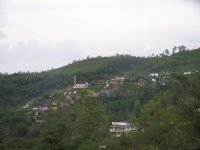


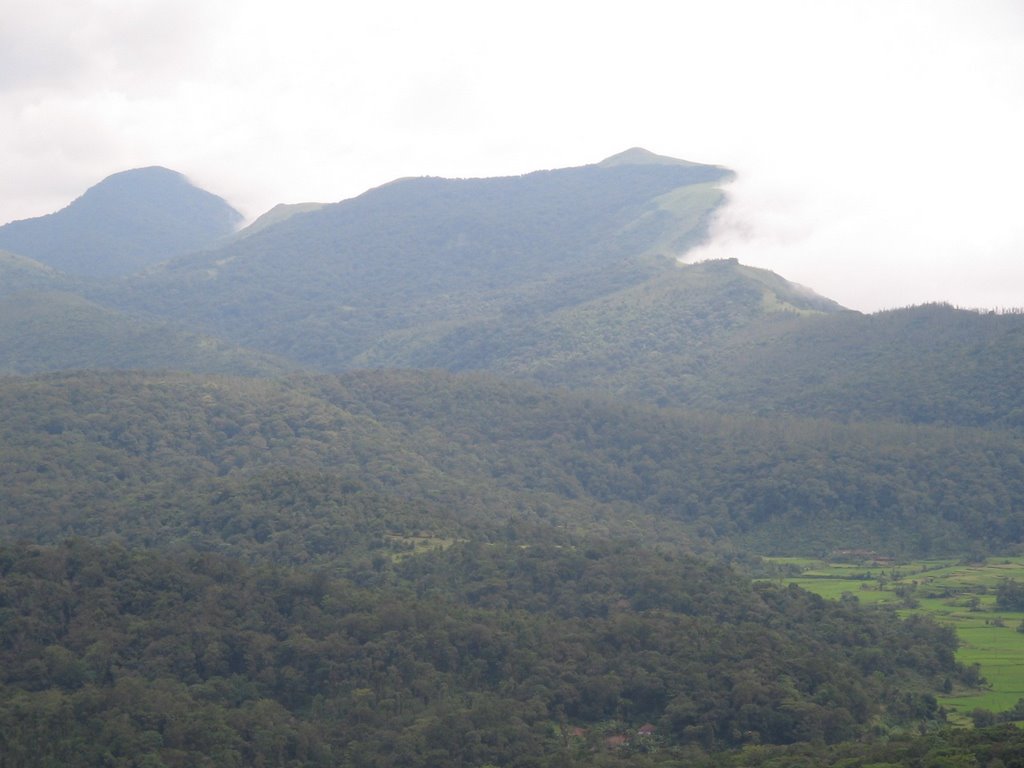
It was "pristine" just as the travel brochures promised it would be. We were surrounded by more beauty than we could absorb!
Friday, September 01, 2006
A To-Do list for Podmoza
My friend Padmaja (Podmoza in our circles) has recently left for the US of A to study more Economics. As is usually the case, a lot of us had been making lists of all that we simply had to tell Podmoza ( Za here on) before she boarded that plane. We have managed to convey most of what we wanted to but what remains are some hopelessly inane tips and pointers that we are still bursting with. Suchitra and I decided that this blog would probably be an appropriate place to spill it all out. That way, anyone else who would like to add to this list can easily do so.
Za, this is for you from Such and me ( so you already know what to expect :D):
1. Develop an exotic accent to create an 'exotic foreigner' image. We don't want you to be associated with any 'typical Indian student in American University' image. No Za, no stereotypes for you! Do weird things like making the accent sound different at different times of the day.
2. Read whacky journal articles like the one that links the Wizard of Oz with events related to the Gold Standard and quote them somewhere in your discussions.
3. Do invent your own Theory of Everything. Ensure that you can answer questions on anything. ( We have an example of one such theory on Pimples which shall be e-mailed to you)
4. Silly questions deserve sillier answers. We do not think you will face too many of those but it would be wise to be prepared. Trace your links to some Indian royal family just in case the topic arises. If the topic does come up, tell the authorities that by your line's constitution, you refuse to pay for education.
5. This one's important- Rave about Bangy and MCC and the coffee and the Adigas vada sambhar and the CTR food!! Do your bit to save our city from getting stuck with the plain old Silicon Valley/ Electronic City image. Deliver a "Power of CTR Masala Dosa" lecture series to anyone who you think deserves to hear it.
There are a lot more tips coming your way Za. But we prefer to give our tips in small doses. Anyone else who has similar/dissimilar tips regarding Economics/ campus life/ Life/ anything at all to offer to Podmoza is welcome!
P.S- Za. we miss you man! Keep us updated on all that you find exciting in the Economics you learn!
Za, this is for you from Such and me ( so you already know what to expect :D):
1. Develop an exotic accent to create an 'exotic foreigner' image. We don't want you to be associated with any 'typical Indian student in American University' image. No Za, no stereotypes for you! Do weird things like making the accent sound different at different times of the day.
2. Read whacky journal articles like the one that links the Wizard of Oz with events related to the Gold Standard and quote them somewhere in your discussions.
3. Do invent your own Theory of Everything. Ensure that you can answer questions on anything. ( We have an example of one such theory on Pimples which shall be e-mailed to you)
4. Silly questions deserve sillier answers. We do not think you will face too many of those but it would be wise to be prepared. Trace your links to some Indian royal family just in case the topic arises. If the topic does come up, tell the authorities that by your line's constitution, you refuse to pay for education.
5. This one's important- Rave about Bangy and MCC and the coffee and the Adigas vada sambhar and the CTR food!! Do your bit to save our city from getting stuck with the plain old Silicon Valley/ Electronic City image. Deliver a "Power of CTR Masala Dosa" lecture series to anyone who you think deserves to hear it.
There are a lot more tips coming your way Za. But we prefer to give our tips in small doses. Anyone else who has similar/dissimilar tips regarding Economics/ campus life/ Life/ anything at all to offer to Podmoza is welcome!
P.S- Za. we miss you man! Keep us updated on all that you find exciting in the Economics you learn!
Sunday, August 13, 2006
A paperback and a window seat
Lord Emsworth leaves Blandings for London
And the engine chokes to life
A loud vile cry declares departure
And the bus heads westwards
From the window, familiar city landscapes
Fibre-glass towers and screaming billboards
Turn into fields of paddy and sugarcane
In Paris, Elise finds love.
The engine's humming lulls me to a dream-enriched sleep
That angry honks and high-beams shatter easily.
Arezki is arrested, Elise ridiculed.
Outside, a child in an over-sized shirt
That has safety-pins filling in for buttons chases hens.
A country is partitioned, an exodus follows
Men of steel watch madness make butchers of others
And I dream of angry assasins.
The highway is clear and the bus gains momentum,
Beyond the lake, lights from the suburban porches announce the destination's approach.
A pig turns dictator and I step out to Terra Firma and reality
From that manic trance of confused reality, fiction and dreams
That a paper-back and a window seat evoke.
And the engine chokes to life
A loud vile cry declares departure
And the bus heads westwards
From the window, familiar city landscapes
Fibre-glass towers and screaming billboards
Turn into fields of paddy and sugarcane
In Paris, Elise finds love.
The engine's humming lulls me to a dream-enriched sleep
That angry honks and high-beams shatter easily.
Arezki is arrested, Elise ridiculed.
Outside, a child in an over-sized shirt
That has safety-pins filling in for buttons chases hens.
A country is partitioned, an exodus follows
Men of steel watch madness make butchers of others
And I dream of angry assasins.
The highway is clear and the bus gains momentum,
Beyond the lake, lights from the suburban porches announce the destination's approach.
A pig turns dictator and I step out to Terra Firma and reality
From that manic trance of confused reality, fiction and dreams
That a paper-back and a window seat evoke.
Sunday, July 16, 2006
The Brat Gang
Recently, I was at a family gathering in the outskirts of Bangalore where I got to meet some of my relatives I hadn't met in ages. I was returning home with some of them who are based in the US and had come to India for the summer holidays. It was a long journey home and there was this one young gentleman who took up the task of keeping me company solely upon his tender shoulders - five year old Sharat who was visiting India for the first time!
When I got into the car, he was wondering why I was coming along with him and his parents and like any good five year old, asked his parents the reason for the anomaly. His parents patiently explained that there was no cause for concern and that 'the girl' (moi) coming along with them was in fact, his sister(to keep things simple). 'I have a sister?!' he startled. After some convincing on the part of his parents, he swallowed the fact and after some deep thinking, decided that he would like to get to know me, his newly discovered sister, better. 'So how old is my sister?' he asked his father. His father told him that it would be a good idea to direct the question to the sister herself. On being quizzed, I asked him how old he thought I was. Now for what follows, let me just tell the people who do not know too many five year olds. Sharat knows all the numbers and he knows more than what a kid his age would typically know. It is just that at that age, kids do not correlate the concept of age and the numbers they have learnt together.One more detail to understand what follows - I'm 22.
Sharat decided to give the puzzle a try and asked me 'You are thirteen?' . 'Sharat, your sister has finshed college and is working now.' , his father said to help him arrive at the answer. 'And people go to college at 21,right?' the kid asked his father. 'Yes, so what comes after twenty one?' his father prompted. 'She's older than 21...' Sharat thought aloud and he turned to me and asked' so you are......41?'. When a kid as cute as Sharat is says something like that in all earnestness, it hard not to pinch his cheeks and give him a big hug. But I had to fight all such instincts as he was yet to fully validate the ties that give me the right to do all of that. Later on during the journey, he warmed up to the fact that he had a sister and seemed pleased about it too. He spoke to me about what he thought about India (which he first thought was a place in Bangalore and was corrected by his mother), the autorickshaws and the autorickshaw drivers, rockets, cars, helicopters, gravity (that was an exceptionally gripping discussion), music and all that he thought I was entitled to know about him by virtue of being his sister. That is one entertaining journey I will remember fondly.
On a related note, last week we had a surprise visit by a distinguished young guest - seven year old Murali. He had allegedly thrown a tantrum at home about wanting to talk to his 'Ranjini akka' (I'm called Ranjini at home and akka means didi). So, his father had to chauffer him to our home one evening. On asking Murali what it was that he wanted to talk to me about, he told me all about his school, the Wright brothers, the Arctic tern and him wanting to join the army. Murali also happens to be an excellent dancer and loves all sports, especially cricket. So he actually enacted an entire scene typically seen while watching any cricket match on TV , which is when there has been a run-out and an appeal is made to the third umpire and there are umpteen replays shown on our screens. Murali enacted the replays and showed how the batsman is shown to move back and forth across the crease and how the fielder is shown to toss the ball towards the stumps. The best part was that he was showing how all of this looks in a replay! As a finale, he even showed the bowler's disappointed reaction when the decision is a not-out. It was a spellbinding performance that day!
It is wonderful to get to know these little brats who are otherwise amongst others of their own kind and are always upto mischief in some unseen corner of the house. It is amazing how they can turn out to be great friends!
When I got into the car, he was wondering why I was coming along with him and his parents and like any good five year old, asked his parents the reason for the anomaly. His parents patiently explained that there was no cause for concern and that 'the girl' (moi) coming along with them was in fact, his sister(to keep things simple). 'I have a sister?!' he startled. After some convincing on the part of his parents, he swallowed the fact and after some deep thinking, decided that he would like to get to know me, his newly discovered sister, better. 'So how old is my sister?' he asked his father. His father told him that it would be a good idea to direct the question to the sister herself. On being quizzed, I asked him how old he thought I was. Now for what follows, let me just tell the people who do not know too many five year olds. Sharat knows all the numbers and he knows more than what a kid his age would typically know. It is just that at that age, kids do not correlate the concept of age and the numbers they have learnt together.One more detail to understand what follows - I'm 22.
Sharat decided to give the puzzle a try and asked me 'You are thirteen?' . 'Sharat, your sister has finshed college and is working now.' , his father said to help him arrive at the answer. 'And people go to college at 21,right?' the kid asked his father. 'Yes, so what comes after twenty one?' his father prompted. 'She's older than 21...' Sharat thought aloud and he turned to me and asked' so you are......41?'. When a kid as cute as Sharat is says something like that in all earnestness, it hard not to pinch his cheeks and give him a big hug. But I had to fight all such instincts as he was yet to fully validate the ties that give me the right to do all of that. Later on during the journey, he warmed up to the fact that he had a sister and seemed pleased about it too. He spoke to me about what he thought about India (which he first thought was a place in Bangalore and was corrected by his mother), the autorickshaws and the autorickshaw drivers, rockets, cars, helicopters, gravity (that was an exceptionally gripping discussion), music and all that he thought I was entitled to know about him by virtue of being his sister. That is one entertaining journey I will remember fondly.
On a related note, last week we had a surprise visit by a distinguished young guest - seven year old Murali. He had allegedly thrown a tantrum at home about wanting to talk to his 'Ranjini akka' (I'm called Ranjini at home and akka means didi). So, his father had to chauffer him to our home one evening. On asking Murali what it was that he wanted to talk to me about, he told me all about his school, the Wright brothers, the Arctic tern and him wanting to join the army. Murali also happens to be an excellent dancer and loves all sports, especially cricket. So he actually enacted an entire scene typically seen while watching any cricket match on TV , which is when there has been a run-out and an appeal is made to the third umpire and there are umpteen replays shown on our screens. Murali enacted the replays and showed how the batsman is shown to move back and forth across the crease and how the fielder is shown to toss the ball towards the stumps. The best part was that he was showing how all of this looks in a replay! As a finale, he even showed the bowler's disappointed reaction when the decision is a not-out. It was a spellbinding performance that day!
It is wonderful to get to know these little brats who are otherwise amongst others of their own kind and are always upto mischief in some unseen corner of the house. It is amazing how they can turn out to be great friends!
For Mumbai and Srinagar after 7/11....
A prayer that all the causes, issues and discontentment that lead to such flagrant acts of cruelty may one day be completely eliminated......
Monday, May 15, 2006
\chapter{Bangalore Again}
What does the title mean, you ask? Well, It means that I have finished my course in IGIDR, Mumbai and have come home to Bangalore and will be working here. It also means that I had been writing my thesis in LaTeX and sitting long hours in front of the computer has done some damage to my already modest literary skills and that explains the unimaginative title.
But this post is more about leaving Mumbai than about coming to Bangalore. That is not to say that I am not excited about being back in Bangy! I am absolutely delighted to be here! However, it is only now that I have begun to realise how much I will miss IGIDR and Mumbai.
Two years ago, around this time, I was wrtiting the IGIDR entrance exam and was very anxious to clear it. After attending the interview a little more than a month later (7th of July, 2004), I fell in love with the institute and would have given anything to be given a chance to study in IGIDR. Looking back now, at all that I have learnt in the two years that I was in the institute, I feel extremely fortunate for the opportunity I was granted. In terms of academics, all the Economics that I know (which isn't very much) is what I have learnt here. I owe a lot to my professors but shall not attempt to express my gratitude towards them on this blog- I will not be able to convey all that I feel. There is more that I have gained from this experience apart from some knowledge of Economics, a degree and a job. To be honest, I did not feel this way about the place from the beginning. I was depressed, lonely and cynical for nearly three out of four semesters. The fourth semester has proved to be an eye-opener.
I realised how much I enjoy the company of my friends here and how important they are to me. There was the usual pressure of assignments and tests this time too but somehow, it did not seem half as taxing as it did in the earlier semesters. If I have to sum it all up, it began to seem like this was just the right thing to happen. It is as if I had to go though it all - the pressure, the loneliness, the frustration, the thrills, the highs, the laughter, the feeling of belonging...since I got to learn a hell of a lot from all these experiences. Two years in IGIDR has proved to be enriching in many ways and for that, I have to thank my friends! Thank you for being the wonderful people you are! I shall treasure the memories of the time we spent together!
P.S: A thousand apologies for the hackneyed cliché but I really do mean it!
But this post is more about leaving Mumbai than about coming to Bangalore. That is not to say that I am not excited about being back in Bangy! I am absolutely delighted to be here! However, it is only now that I have begun to realise how much I will miss IGIDR and Mumbai.
Two years ago, around this time, I was wrtiting the IGIDR entrance exam and was very anxious to clear it. After attending the interview a little more than a month later (7th of July, 2004), I fell in love with the institute and would have given anything to be given a chance to study in IGIDR. Looking back now, at all that I have learnt in the two years that I was in the institute, I feel extremely fortunate for the opportunity I was granted. In terms of academics, all the Economics that I know (which isn't very much) is what I have learnt here. I owe a lot to my professors but shall not attempt to express my gratitude towards them on this blog- I will not be able to convey all that I feel. There is more that I have gained from this experience apart from some knowledge of Economics, a degree and a job. To be honest, I did not feel this way about the place from the beginning. I was depressed, lonely and cynical for nearly three out of four semesters. The fourth semester has proved to be an eye-opener.
I realised how much I enjoy the company of my friends here and how important they are to me. There was the usual pressure of assignments and tests this time too but somehow, it did not seem half as taxing as it did in the earlier semesters. If I have to sum it all up, it began to seem like this was just the right thing to happen. It is as if I had to go though it all - the pressure, the loneliness, the frustration, the thrills, the highs, the laughter, the feeling of belonging...since I got to learn a hell of a lot from all these experiences. Two years in IGIDR has proved to be enriching in many ways and for that, I have to thank my friends! Thank you for being the wonderful people you are! I shall treasure the memories of the time we spent together!
P.S: A thousand apologies for the hackneyed cliché but I really do mean it!
Tuesday, March 07, 2006
Oikos Nomikos
In a 1997 article titled " How did Economics get that way and what way did it get? ", Robert M. Solow concludes by saying:
" Oscar Wilde described a fox hunt as the unspeakable in pursuit of the inedible. Perhaps here we have the overeducated in pursuit of the unknowable. But it sure beats the alternatives. "
The article describes how the study of Economics has evolved over the past few decades into its current model-centric form. It suggests that the shifting of the centre of gravity of research in Economics from Britain to the United States could be one possible explanation. It also involves interesting comparisons of Economics with other sciences, mainly Physics and Biology.
The process of learning Economics has served in showing how wide-spread and fascinating its applications are. It is almost seems like there is nothing that falls outside the scope of Economics, that the scope of this science that started out as the science of household management, is infinite!
" Oscar Wilde described a fox hunt as the unspeakable in pursuit of the inedible. Perhaps here we have the overeducated in pursuit of the unknowable. But it sure beats the alternatives. "
The article describes how the study of Economics has evolved over the past few decades into its current model-centric form. It suggests that the shifting of the centre of gravity of research in Economics from Britain to the United States could be one possible explanation. It also involves interesting comparisons of Economics with other sciences, mainly Physics and Biology.
The process of learning Economics has served in showing how wide-spread and fascinating its applications are. It is almost seems like there is nothing that falls outside the scope of Economics, that the scope of this science that started out as the science of household management, is infinite!
Saturday, February 18, 2006
Transmutation
Morphed in a flash,
Simplified, trimmed down and concised;
As an abridged pocket-sized chef d'oeuvre,
Dimensions lost
Comprehension gained.
Simplified, trimmed down and concised;
As an abridged pocket-sized chef d'oeuvre,
Dimensions lost
Comprehension gained.
Thursday, February 09, 2006
Thank you for the music!
That's what I would like to say to the Kannada film industry! Now, that would appal anyone who's even remotely familiar with the kind of music that's being generated in Sandalwood (that's what the Kannada film industry is called)! But something that happened today helped me see things differently.
This evening, after dinner, I picked up a tape at random and played it. It happened to be a collection of songs I had recorded from the radio in Bangalore that I hadn't listened to for a long time now. One particular song in the tape changed my mood entirely. The song is called " Car Car" and is all about these marvellous locomotives that have changed our lives. The video alternatively features highways of the USA and the humble roads of namma Bengalooru(and this was shot when the fly-overs were being constructed- not a pretty sight at all!) during rush hour traffic. The chorus goes "Car car car car yelnodi car (2)"! The absolute meaninglessness of this song is what makes it endearing. Added to that is the fact that it is sung by some talented play-back singers. I enjoyed it so much that I actually felt refreshed after listening to it!
Every now and then, Bollywood tries hard to come up with crass, meaningless numbers- but on this one count, Sandalwood outsmarts its big brother in Mumbai. It is only in Kannada movies that we have songs like "Colour colour" and this other song, the chorus of which goes something like:
"Danger, 16 to 20 danger
20 to 30 hunter
30 to 40 soldier........"
No prizes for guessing what this song is all about. And I swear these are all real songs in real movies!
I do not know if these songs are written by lyricists (if they actually hire lyricists to write them) who have little kids at that crucial stage of childhood when their rate of absorption of new words into their vocabulary is at its peak. Perhaps, these songs are innovative tools devised by the smart lyricist-parents for feeding some important words of every Kannadiga's favourite language (viz.,angrezi) into their kids' long-term memory.
Regardless of the actual reasons behind the songs, I thank the persons behind them for making them. If these songs did not exist there would have been an implacable void in the universe!
This evening, after dinner, I picked up a tape at random and played it. It happened to be a collection of songs I had recorded from the radio in Bangalore that I hadn't listened to for a long time now. One particular song in the tape changed my mood entirely. The song is called " Car Car" and is all about these marvellous locomotives that have changed our lives. The video alternatively features highways of the USA and the humble roads of namma Bengalooru(and this was shot when the fly-overs were being constructed- not a pretty sight at all!) during rush hour traffic. The chorus goes "Car car car car yelnodi car (2)"! The absolute meaninglessness of this song is what makes it endearing. Added to that is the fact that it is sung by some talented play-back singers. I enjoyed it so much that I actually felt refreshed after listening to it!
Every now and then, Bollywood tries hard to come up with crass, meaningless numbers- but on this one count, Sandalwood outsmarts its big brother in Mumbai. It is only in Kannada movies that we have songs like "Colour colour" and this other song, the chorus of which goes something like:
"Danger, 16 to 20 danger
20 to 30 hunter
30 to 40 soldier........"
No prizes for guessing what this song is all about. And I swear these are all real songs in real movies!
I do not know if these songs are written by lyricists (if they actually hire lyricists to write them) who have little kids at that crucial stage of childhood when their rate of absorption of new words into their vocabulary is at its peak. Perhaps, these songs are innovative tools devised by the smart lyricist-parents for feeding some important words of every Kannadiga's favourite language (viz.,angrezi) into their kids' long-term memory.
Regardless of the actual reasons behind the songs, I thank the persons behind them for making them. If these songs did not exist there would have been an implacable void in the universe!
Subscribe to:
Posts (Atom)